Culture Isn't What You Post. It's What You Let Slide.
- 2 days ago
- 4 min read
Integrity. Teamwork. Respect.
Usually framed, usually near the host stand, usually irrelevant by 8 PM on a Friday.
That's when the real test shows up. Kitchen's down a cook. A manager's under pressure. A top performer just said something ugly to the new hire.
Nobody's checking the wall. They're watching the leader.
That's culture. Not the words. Twenty years running restaurants taught me that first.
I've seen "people-first" companies burn out their best people on the schedule. I've seen accountability preached, then waived for whoever hits the numbers. I've seen teamwork celebrated while the loudest person takes the credit.
The team always clocks the gap. They notice the server written up for five minutes late while a favored manager strolls in whenever. The toxic chef protected because the food sells. The manager who takes the win and vanishes when it breaks.
They notice the opposite too. The leader who walks onto the floor during a brutal service instead of hiding. The mistake corrected without humiliation. The dishwasher treated like the top salesperson. That second list is culture too. Most companies just talk about it instead of living it.
Values Are What You Say. Culture Is What You Tolerate.

Real Companies That Actually Live This
A few companies have made the values-to-behavior connection real instead of decorative.
Costco built its reputation on treating employees well before it built anything else, paying above industry norms and promoting from within, and that decision shows up directly in one of the lowest turnover rates in retail.
Patagonia backs its stated values with things you can actually measure: on-site child care, paid time off for environmental activism, and supply chain standards it enforces rather than just publishes. The company's own standard is that actions have to match the words, not the other way around.
Netflix took a sharper, more controversial route: radical transparency, blunt feedback, and real freedom paired with real responsibility, laid out explicitly enough that new hires know exactly what they're walking into before day one. Not every company should copy it. But nobody can accuse Netflix of hiding the ball.
None of these companies are perfect, and copying their specific programs isn't the point. The point is that culture became credible the moment decisions started backing up the language.
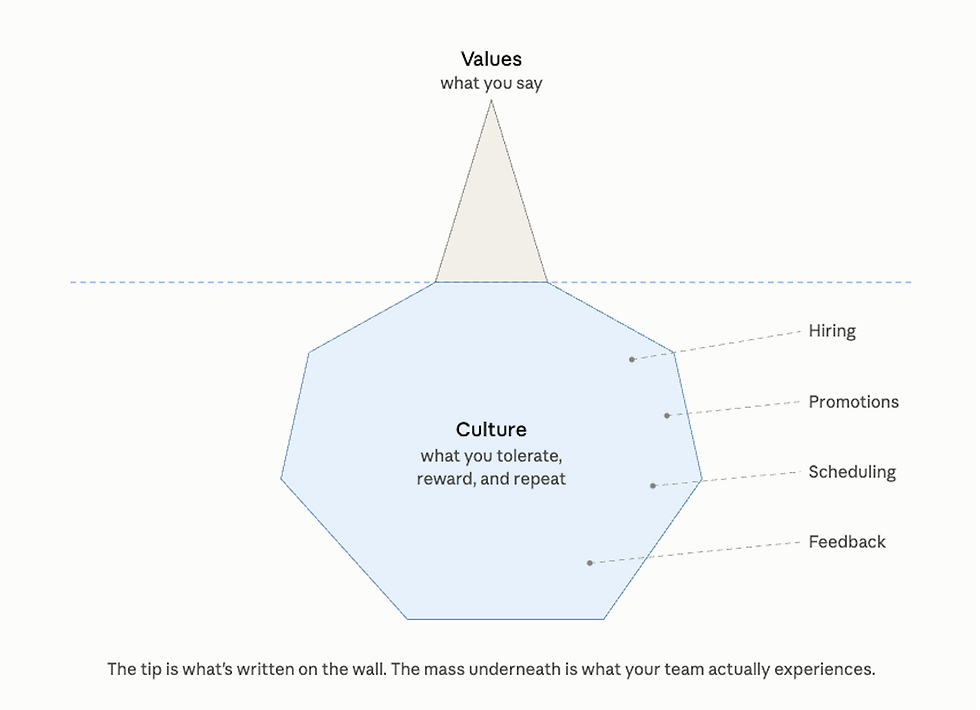
Where Culture Actually Lives
Forget the handbook. Culture shows up in six places, and none of them are on a wall.
Hiring. Who gets through the door, and does the interview process actually test for how someone treats people under pressure, or just whether they can recite the right answers.
Promotions. Does the person who develops others move up, or does the person who's simply loudest and most political get the title.
Scheduling. Do your best people get protected from burnout, or get quietly punished for being reliable by having every gap filled with their name.
Accountability. Does a rule apply to everyone, or does it bend for whoever brings in the most revenue.
Feedback. Does a mistake get corrected like a coaching moment, or does it turn into a public humiliation that teaches everyone else to hide their next mistake instead of reporting it.
Terminations. When someone finally gets let go for how they treat people, does it happen quickly, or does it take eighteen months because their numbers were too good to touch.
Every one of those six moments is a culture decision disguised as an operational one. Nobody calls it culture in the moment. Everybody feels it anyway.
A Short Checklist for Anyone Willing to Look Honestly
Ask these out loud, in your own company, and actually wait for the honest answer.
Who got promoted this year, and why.
Who has the best shifts, and have you ever asked why.
What happened the last time a top performer hurt the team. Did anything happen at all.
Are your managers developing people, or just hitting labor targets and calling it leadership.
When something goes wrong, does your team look for the lesson, or does it look for someone to blame.
If the honest answers make you uncomfortable, that discomfort is the most useful data you'll get all year.
What You Tolerate, You Teach
Culture isn't a slogan. It's not a workshop, and it's not a slide deck with a color-coded framework, however satisfying that framework looks pinned to a corkboard.
It's built one scheduling decision, one hard conversation, one promotion, and one bad Friday night at a time.
What you reward gets repeated.
What you ignore becomes the norm.
What you tolerate, you teach, whether you meant to or not.
Your culture was never the sentence on your website. It's the behavior your leadership team allows when the pressure is highest and nobody's watching closely enough to write it down.
So here's the only question that actually matters: the next time your best performer treats someone badly and delivers the numbers anyway, what are you actually going to do about it? Want to talk through your operations rythmics?


Comments