I watched Four Restaurants Open on the Same Block. Only One Made Real Money.
- Jul 17
- 4 min read
Two years ago, I watched four restaurants open on the same block within a few months of each other. A chicken finger spot. A burger joint. A Mexican fast casual. An Asian bowl concept.
Same block. Same rent, roughly. Same foot traffic walking past all four doors.
Eighteen months later, one of them was quietly printing money. One was hanging on. One had already changed hands. I won't tell you which was which, because the point isn't the restaurants. It's the pattern, and I've seen it repeat itself for twenty years now.
Everyone assumes the food decides who wins. It doesn't. The operating model decides who wins. The food just gets people through the door.
The Chicken Finger Place Was Doing Less, on Purpose
Here's the thing about a chicken finger concept: the menu is almost embarrassingly narrow, and that's exactly why it works.
One protein. A basket, a sandwich, a wrap, a family meal, all built from the same handful of ingredients. The same fries. The same three sauces. Training takes a day, not a month, because there's simply less to get wrong.
Every ingredient you add to a menu is a small tax you pay forever. Another thing to order, store, prep, portion, teach, and eventually throw away when it doesn't sell. The chicken finger concept just doesn't pay most of those taxes.
It's not that chicken is magic. It's that focus is.
The Burger Joint Looked Simple and Wasn't
Burgers are the easiest sell in America. Everyone wants one, they travel fine, and they work for lunch, dinner, and every meal in between.
But run the kitchen for a week and you'll see the truth: beef prices swing, you're juggling four cook temperatures at once, and somebody always wants no bun, extra pickle, sauce on the side. Add delivery apps into the mix and a "simple" burger becomes a genuinely complicated production line.
The burger places that actually make money are the ones brave enough to say no to half their own menu. Fewer variations, faster line, a clear point of view about what a burger from this place is supposed to be. Popularity without discipline just means you're busy and broke at the same time.
The Mexican Fast Casual Had a Secret Weapon: Math
Rice, beans, tortillas, a handful of proteins, a few sauces. It sounds limited on paper. On the line, it's a small number of ingredients getting recombined into bowls, burritos, tacos, and salads in a way that feels like abundance to the guest and feels like sanity to the kitchen.
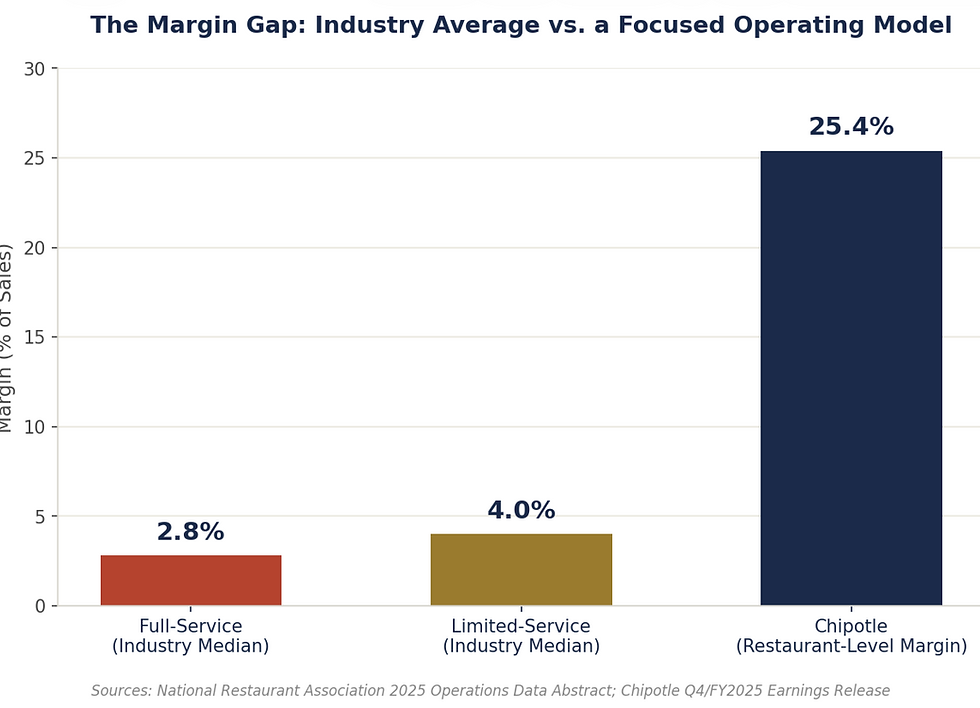
That's not a small thing. Chipotle posted a 25.4% restaurant-level operating margin for all of 2025, a number most restaurant categories can only dream about. That's before corporate overhead, and it's not a fair comparison for a single independent restaurant, but it tells you something real about what happens when a menu is built for cross-utilization from day one.
It's not effortless, though. Fresh prep, multiple proteins, made-to-order salsa, that's real labor, and a busy Mexican fast casual can still lose money if the back of house isn't dialed in.
"Asian" Is Not One Business. It's a Trap Word.
This is the one that gets people. "Asian restaurant" isn't a business model, it's a whole continent's worth of them wearing a trench coat.
A tight teriyaki or noodle or rice-bowl concept, built around a handful of shared bases, can run beautifully. Wok stations move fast, flavors punch above their cost, and the kitchen stays sane.
Try to do sushi, ramen, dumplings, and stir-fry under one roof, though, and you haven't built one restaurant. You've built four restaurants sharing a lease and a walk-in. The guest sees abundance. The kitchen feels the chaos. Pick a lane and the economics follow.

Does a Kiosk Fix Any of This? No.
Everyone wants to know if automation is the answer. It isn't, not by itself.
Wingstop's digital sales hit 72.8% of systemwide sales in the third quarter of 2025, proof that ordering technology can become deeply embedded in a focused concept. But a kiosk bolted onto a messy menu just lets orders hit the kitchen faster than the kitchen can keep up. Technology doesn't fix a bad operating model. It just reveals it faster.
The best use of automation is invisible: it kills the repetitive admin work, sharpens forecasting, and gives your team more time for the parts only humans do well, actual hospitality.
So What's the Real Answer?
There's no winning cuisine. There's a winning shape.
The National Restaurant Association's 2025 data put median pre-tax income at 4.0% of sales for limited-service restaurants and 2.8% for full-service. Thin margins everywhere, which is exactly why the operating model matters more than the menu ever will.
The concepts that make real money share the same bones: a focused menu, heavy ingredient reuse, demand across multiple dayparts, fast production, low waste, and a system built to repeat without falling apart at unit five.
The food gets them in the door. The operating model decides if you keep the lights on.
If you're opening, repositioning, or trying to figure out why a busy restaurant isn't a profitable one, that's exactly the conversation I have for a living. Let's talk.


Comments